
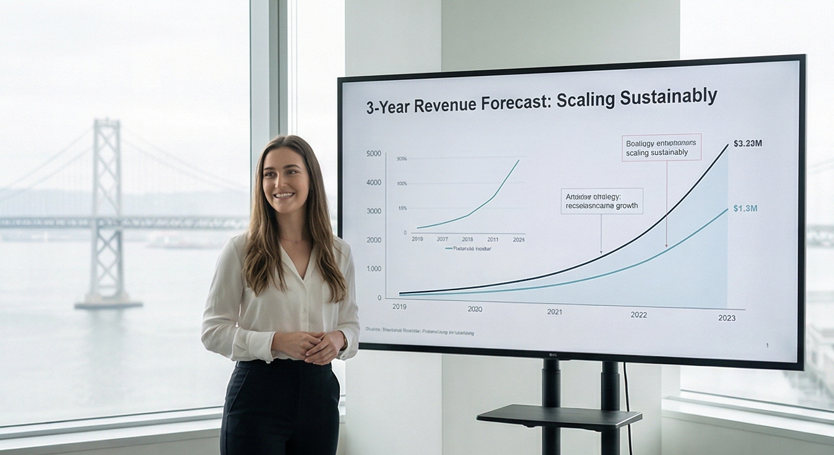
The venture capital landscape is fiercely competitive, with only a fraction of startups successfully securing institutional funding each year. 1 At the absolute core of any successful fundraising campaign lies the Financial slide pitch deck.
Investors rely entirely on these projections to validate your underlying business model and assess the founding team’s strategic competence. For software-as-a-service (SaaS) companies, this challenge is magnified. visualizing SaaS metrics requires a delicate balance between providing granular operational insights and maintaining a clean, digestible format. This guide explores the methodologies required to craft high-converting financial projections without inducing cognitive overload.
The Strategy and Psychology Behind the Numbers
Venture capitalists review thousands of pitch decks annually, spending an average of just 3 to 4 minutes on a complete presentation. Consequently, founders possess an incredibly narrow temporal window to communicate their value.
If a financial slide is densely packed with microscopic text and convoluted charts, it immediately triggers cognitive friction. A minimalist, strategically designed slide facilitates rapid comprehension. Elite design dictates that strategy must always precede aesthetics. Your financial projection slide is not merely a graphic design exercise; it is the ultimate stress test of your operational blueprint.
Core Architectural Components
Founders must meticulously extract critical key performance indicators (KPIs) from their internal models rather than pasting an entire profit and loss statement. The financial narrative must be ruthlessly curated to highlight operational momentum.
| Financial Component | Strategic Purpose | Investor Implication |
| Revenue Forecasts | Demonstrates top-line growth potential over a 3-5 year horizon. | Validates market size and pricing model viability. |
| Expense Breakdown | Categorizes capital allocation across R&D, Sales, and Operations. | Proves leadership understands capital efficiency. |
| Gross Margin | Shows revenue retained after cost of goods sold. | Indicates long-term profitability and pricing power. |
| Burn Rate & Runway | Details cash outflow and time until funds are depleted. | Assures investors the requested capital provides sufficient time. |
Deep Dive: Visualizing SaaS Metrics with Absolute Clarity
For SaaS enterprises, visualizing SaaS metrics requires the precise articulation of recurring revenue, customer retention, and acquisition efficiencies.
- MRR and ARR: Highlight the velocity of growth using clean line charts. Overlay raw data with smoothed trendlines to mitigate the visual noise of short-term spikiness.
- LTV to CAC Ratio: Institutional investors look for a ratio of at least 3:1. Visualize this dynamic with a stark, color-coded side-by-side bar chart or bold typography.
- Net Revenue Retention (NRR): Prove product stickiness through comprehensive cohort analysis. A tabular format enhanced with heatmap conditional formatting is the gold standard for transparency.
- Payback Period: Capital efficiency is paramount. Use a horizontal bar chart to track the exact timeline to the break-even threshold.
Tailoring Projections by Funding Stage
A one-size-fits-all approach frequently derails fundraising efforts. The granular detail must be meticulously calibrated to the startup’s current maturity.
- Pre-Seed and Seed: Focus on validating early market traction. Keep projections exceptionally streamlined to a single, high-impact page emphasizing bottom-up revenue targets and basic unit economics.
- Series A: Prove the mathematical scalability of the go-to-market strategy. Investors expect comprehensive 3-5 year projections, deeply sustainable LTV to CAC ratios, and flattening cohort retention curves.
- Series B & Beyond: The focus pivots toward deep operational efficiency. Elite Series B decks utilize data-rich slides to prove absolute dominance in user retention and repeatable sales pipeline velocity.
The McKinsey Approach & Avoiding Red Flags
Even a mathematically sound financial model will fail if the visual delivery is compromised. Elite presentation design, championed by global consulting firms like McKinsey & Company, relies on profound minimalism.
- Action Titles: Instead of generic headers, every slide must feature a complete sentence that explicitly communicates the primary strategic takeaway.
- Strategic Whitespace: Maintain at least 30% to 40% empty space around charts to guide the viewer’s eye and prevent cognitive confusion.
- No Spreadsheet Screenshots: Never paste an unreadable Excel sheet onto a slide. A pitch deck is a storytelling medium, not a forensic auditing document.
- Contextual Annotations: If there is a noticeable historical dip in revenue, use a brief, proactive callout explaining the anomaly to control the narrative trajectory.
Conclusion: Transforming Data into a Strategic Advantage
The Financial slide pitch deck represents the ultimate crucible for startup founders. By embracing a strategy-first approach, prioritizing absolute visual clarity, and precisely aligning specific SaaS metrics with the appropriate funding stage, founders can transform this daunting requirement into a persuasive asset.
For enterprises seeking to elevate their fundraising materials, partnering with dedicated professionals provides a decisive edge. TEAMPPT specializes in distilling highly complex business intelligence into sophisticated, visually arresting pitch decks. By rigorously applying the analytical frameworks utilized by top-tier global consulting firms, TeamPPT ensures that your financial projections actively drive the successful capitalization of your business vision.