In the high-stakes world of global business, your presentation is often the only proxy for your company’s competence. Whether you are a startup founder facing a Venture Capitalist or a sales director pitching to a Fortune 500 client, the slide deck is your weapon. Yet, a silent killer is lurking in the folders of countless organizations: the “Frankendeck.”
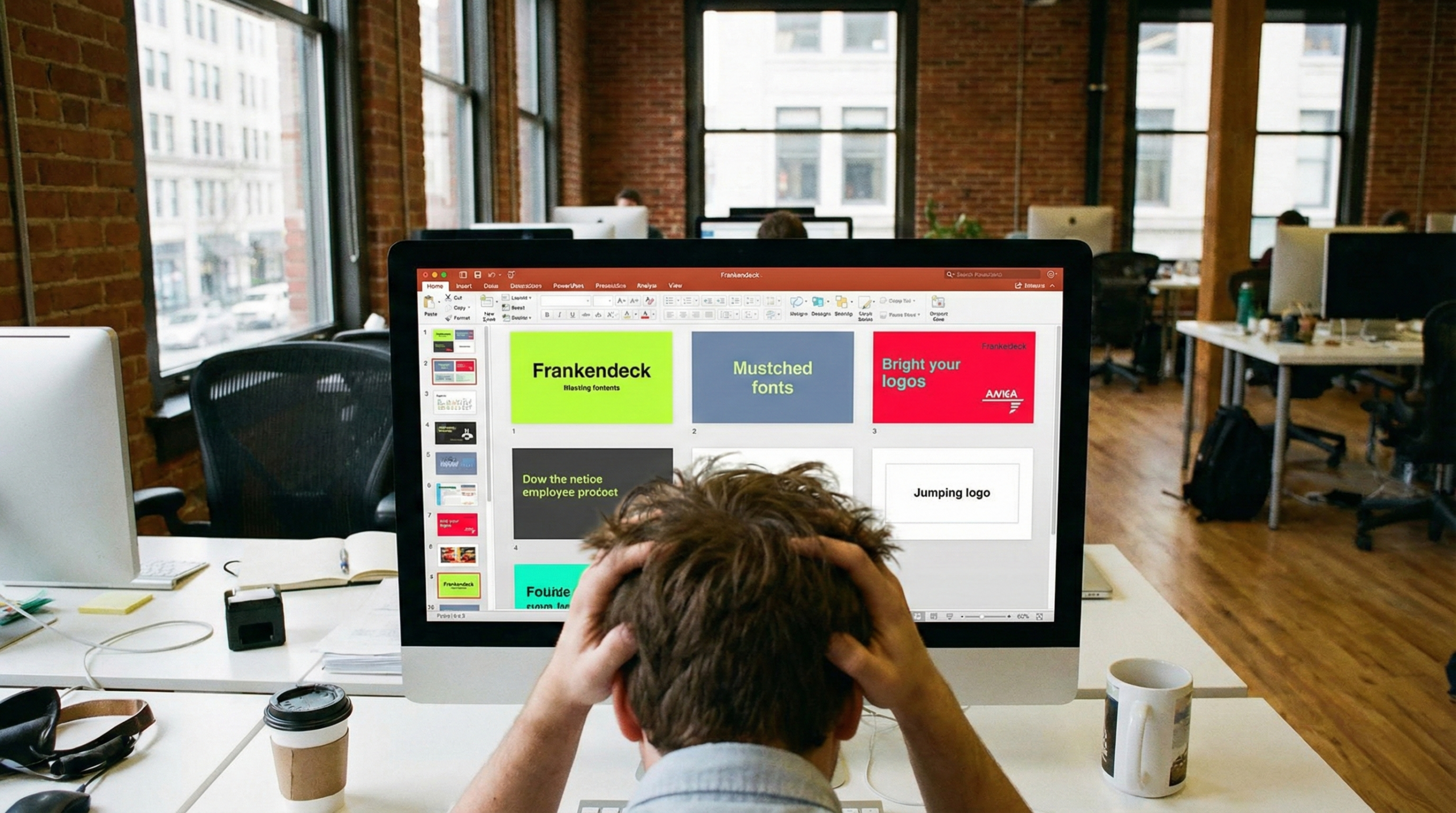
We have all seen it. It’s the monster stitched together from five different slide decks, created by three different departments over the last four years. The fonts clash, the logos jump around, and the color palette is a muddy mix of old and new branding. It is not just an aesthetic crime; it is a strategic liability.
At TEAMPPT, we believe that design is the visualization of strategy. In this deep dive, we explore why Brand consistency PowerPoint strategies are not merely about “looking pretty”—they are a critical driver of revenue, trust, and operational efficiency.
1. Anatomy of a Monster: What is a Frankendeck?
The term “Frankendeck” derives from Mary Shelley’s Frankenstein—a creature assembled from mismatched parts. In a corporate context, it represents a presentation file that has been “thrifted.” Instead of building a coherent narrative, employees save time by copying and pasting slides from older files.
The Symptoms of Visual Schizophrenia
A Frankendeck typically exhibits what we call “Visual Schizophrenia.” Marketing’s slides use the 2024 neon palette, while Sales’ slides use the 2020 muted tones. Fonts oscillate between the official brand typeface and the default Calibri.
The Psychological Cost: Cognitive Load
The real damage isn’t artistic; it’s psychological. The human brain craves Cognitive Fluency. When information is visually consistent, the brain processes it easily and perceives it as trustworthy. Conversely, when a viewer encounters inconsistent formatting, their brain experiences “Cognitive Load.” They stop listening to your strategy and start wondering why the logo moved two inches to the left.
Inconsistency signals a lack of attention to detail. If you cannot manage your fonts, how can a client trust you to manage a multi-million dollar contract?
2. The Financial Case for Consistency
Many executives view corporate template management as a “nice-to-have.” The data suggests otherwise. Brand consistency is a measurable asset with direct financial implications.
Revenue Impact
Research consistently shows a correlation between cohesion and profit. Companies that maintain brand consistency across all platforms—including their sales decks and IR materials—experience an average revenue increase of 23%. Consistency builds familiarity, and familiarity breeds trust.
The Hidden Cost of Rework
Beyond lost revenue, the operational waste is staggering. Without a centralized system, employees waste countless hours searching for the “right” logo or fixing broken formatting.
- Ideally, presentation creation should be seamless.
- In reality, a medium-sized organization can lose over $133,000 annually in wasted staff hours due to inefficient presentation workflows and the need to fix broken slides.
Implementing a robust corporate template management system is not just a design choice; it is a cost-saving operational strategy.
3. High-Stakes Strategy: When Design Equals Dollars
At TEAMPPT, we analyze the pitch decks of global unicorns to understand the link between design and success. In high-pressure environments like Investment Rounds (IR) or Competitive Bidding, the “Frankendeck” is a deal-killer.
3.1. Pitch Decks: Strategy Over Aesthetics
Founders often obsess over “pretty” slides. However, our analysis of Uber and Netflix reveals a deeper truth: Strategy and planning must precede design.
- The Uber Lesson: Uber’s 2009 deck raised $200k, but by modern standards, it was too dense. Today, the strategy is to consolidate complex data (like market size and problems) into a single, concise slide.
- The 7-Second Rule: Investors review dozens of decks daily. You have approximately 7 seconds on the first slide to hook them. A Frankendeck, with its visual clutter, fails this test immediately.
3.2. Bidding Proposals: The Trust Paradox
In competitive bidding (B2B or Government), the proposal is your representative. A “Frankendeck” proposal that ignores the Request for Proposal (RFP) formatting requirements suggests a vendor who will ignore project requirements.
- Consistency is Compliance: Adhering strictly to the visual and structural requirements of an RFP builds trust. It shows you are disciplined and client-focused.
- The Template Trap: While templates help, relying on generic “cookie-cutter” templates without tailoring the strategy to the specific client’s “hidden needs” is a recipe for failure.
4. The Cure: Corporate Template Management
How do you kill the Frankendeck? You cannot rely on willpower alone. You need a system. Effective corporate template management involves technical constraints and strategic asset deployment.
4.1. Lock Down the Slide Master
The root cause of most Frankendecks is the ability for users to “break” the design.
- Technical Control: Use the Slide Master in PowerPoint to lock down logos, legal disclaimers, and brand colors. Users should be able to edit text, not the brand identity.
- Theme Enforcement: Define theme fonts and colors so that even if a user adds a new chart, it automatically adopts the brand palette.
4.2. Centralized Asset Libraries (OAL)
Stop employees from “Google image searching” your logo. Implement an Organization Asset Library (OAL).
- Single Source of Truth: Cloud-based libraries ensure every team member pulls from the same repository of approved slides, icons, and images.
- Updates: When the brand evolves, you update the library, not 500 individual hard drives.
4.3. The Role of AI in Consistency
Artificial Intelligence is the new brand guardian. Tools like Microsoft Copilot can now help enforce brand guidelines by generating slides that align with your pre-defined template, ensuring that speed does not come at the cost of Brand consistency PowerPoint standards.
5. Conclusion: Format is Substance
The death of the Frankendeck is long overdue. In a digital economy where attention spans are shrinking, visual consistency is a proxy for reliability.
A coherent presentation does more than look good—it reduces cognitive load for your investors, builds trust with your clients, and saves your employees hundreds of hours of rework. It transforms your slide deck from a patchwork monster into a strategic asset.
Do not let a Frankendeck speak for your brand.
At TEAMPPT, we bring a strategist’s perspective to design. We don’t just make slides; we engineer persuasive narratives backed by data and psychological principles. Whether you need to overhaul your corporate template management system or craft a winning IR deck, we are your partner in visualizing value.
Ready to professionalize your presentation strategy?